


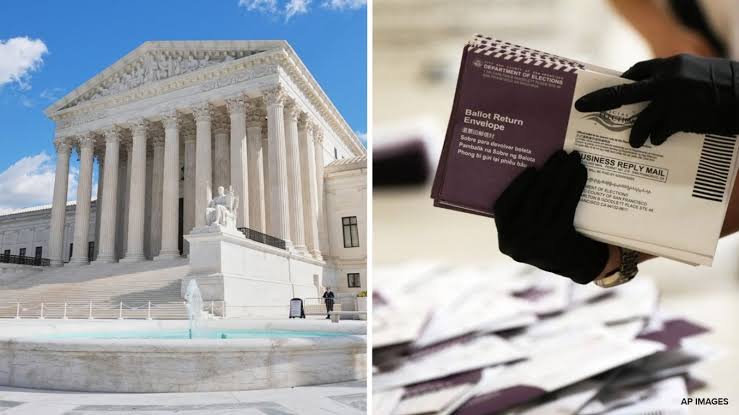
WASHINGTON, November 3, 2026 — The US Supreme Court rejected the Trump administration’s emergency request to make California set aside about 20,000 mail ballots linked to voters federal officials suspect may be noncitizens. The unsigned order, issued late Monday on the eve of Election Day, gave no explanation and recorded no public dissent, leaving lower-court rulings against the requested ballot restrictions in place.
The ruling means California election officials will not be required by this emergency application to segregate the ballots while citizenship checks are conducted. It does not establish that every person on the federal list is eligible to vote, nor does it establish that the list identifies 20,000 unlawful votes. The underlying dispute concerns the reliability of federal data, the practical ability to identify individual ballots after voting procedures are under way, and the constitutional division of authority over elections.
The Justice Department argued that setting the ballots aside would preserve the possibility of checking voters’ eligibility before the ballots were counted. California officials countered that the government’s list was error-prone and that identifying the affected ballots at this late stage would be logistically difficult or impossible. Ballots had already been distributed, returned and processed as the state prepared for the November 3 midterms.
The Supreme Court did not explain its decision. The denial left in place lower-court rulings that found the administration had not shown a basis for the extraordinary emergency remedy it sought. The courts had warned that segregating ballots shortly before voting concluded could disrupt election administration and risk preventing eligible citizens from having their votes counted. The high court’s order was narrow: it declined to intervene in this emergency application rather than issue a full opinion resolving every legal question raised by the case.
The administration’s request was based on a federal list of roughly 20,000 people it described as likely or prospective noncitizen voters. That label is an allegation, not a judicial finding about each person. California challenged the accuracy of the list, and reporting reviewed by The Associated Press and The Washington Post described mismatches and records that did not establish that the people identified were noncitizens who had cast ballots. The government has not publicly demonstrated that 20,000 illegal votes were cast.
At a lower-court hearing, a Justice Department attorney acknowledged that the underlying data had a high error rate, according to AP’s account. A federal prosecutor nevertheless maintained that people listed by the department were ineligible. That disagreement illustrates the evidentiary problem at the centre of the case: a database flag can justify further investigation, but it does not by itself establish a person’s citizenship status or prove that an unlawful vote has been cast.
The case turned not only on voter eligibility but also on who has authority to set and administer election procedures. States have primary responsibility for conducting elections, subject to federal constitutional and statutory requirements. The administration argued that federal officials needed a way to prevent potentially ineligible ballots from being counted; California said the requested order would impose a last-minute change on an election already in progress and could affect lawful voters.
A separate ruling by a federal judge in Washington, DC, found that the administration’s last-minute demands on California election officials likely violated the Constitution’s Elections Clause, which assigns election-rule authority to states and Congress. That decision concerned a related dispute over federal pressure on state election administration. It did not mean the federal government is barred from investigating suspected illegal voting; rather, it questioned whether the specific demands made in this case exceeded the authority available to the executive branch.
The timing mattered. Election officials must prepare ballots, train staff, organise tabulation and resolve eligibility questions under established procedures. A court order issued hours before voting ends can require officials to identify and isolate particular ballots without a reliable method to do so. It can also lead voters to fear that their ballots may be discarded for reasons they cannot easily challenge. Courts have often been reluctant to change election rules at the last minute because even well-intentioned adjustments can produce confusion or disenfranchise eligible voters.
For California, the immediate effect is that the state does not have to carry out the segregation order the administration sought from the Supreme Court. The ruling does not prevent election officials from applying existing eligibility rules, responding to lawful challenges or following other court orders. Nor does it decide how the government may use voter-registration data in future investigations. Those questions can continue through ordinary litigation and administrative processes after Election Day.
For the federal government, the denial is another setback in a series of attempts to compel changes to California’s handling of ballots associated with people whose citizenship the administration questions. Earlier requests were rejected by a district court and an appeals court. The Supreme Court’s refusal to intervene means those decisions remain operative for this election, but the broader debate over federal access to voter data and the limits of executive power is not over.
The order should not be read as a finding that every person on the list is a citizen or that no noncitizen ever appears on a voter roll. It also should not be presented as evidence that the administration uncovered 20,000 unlawful votes. The court declined to impose a specific emergency remedy; it did not publish a factual ruling about each listed voter or issue a comprehensive judgment on the underlying legal claims.
That distinction is central to public confidence. Election safeguards depend on accurate records, fair procedures and a meaningful opportunity to challenge mistakes. A person’s name appearing on a list compiled from government records does not automatically establish citizenship status, and citizenship status alone does not show whether that person registered, voted or cast a ballot in the election. Each step requires evidence appropriate to the question being asked.
The case also highlights the risks of making major procedural changes close to Election Day. State and local officials must balance fraud prevention with the obligation to count eligible votes. If data are incomplete or mismatched, an intervention designed to prevent unlawful voting can also sweep in citizens. Courts assessing emergency applications weigh not only the government’s stated objective but also the likelihood of legal authority, the quality of the evidence and the harm that a last-minute order could cause.
The Supreme Court’s brief order leaves those wider questions open. The Justice Department can continue to investigate suspected violations and pursue legal avenues supported by evidence, while California can continue to administer the election under the rules that remain in force. Any later case would need to address the government’s evidence and legal authority on a fuller record rather than rely solely on an emergency request made immediately before voting concluded.
The next developments to watch are whether the Justice Department seeks further proceedings, how California reports and certifies the election results, and whether the dispute leads to additional litigation over voter-data sharing. For now, the practical result is clear: the Supreme Court did not order California to set aside the disputed mail ballots, and the lower-court rulings remain in effect.




Comments (0)
Be the first to comment. Comments are published after moderation.