


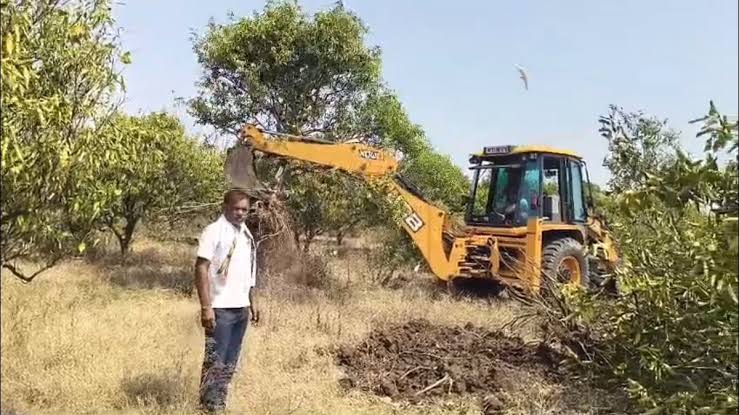
JALNA, November 3, 2026 — Maharashtra drought conditions are reaching beyond the loss of a single seasonal crop. In the state’s fruit-growing belts, farmers are removing immature oranges and watching sweet lime and pomegranate trees dry out after months of inadequate and uneven rainfall. When a mature orchard dies, the loss is measured not only in one harvest but in the years needed to replace the trees and bring them back into production.
Fresh field reporting from The Indian Express describes damage in Jalna’s Ambad taluka and in Vidarbha’s orange-growing villages, where farmers are cutting fruit early in an attempt to preserve trees. Scientists at the ICAR Central Citrus Research Institute in Nagpur warn that the effects could extend across more than one flowering cycle. A new orchard may take about four years to produce its first harvest, making the loss of established trees especially difficult for households that depend on horticulture for regular income.
The state’s final drought declaration covers 305 talukas across 33 districts under the first and second triggers of its drought-management framework. That October 14 Government Resolution followed the end of the monsoon after October 5 and directed district collectors to begin crop assessments. The order provides a set of relief measures, but it does not announce a fixed amount of compensation for individual crop losses.
In Linga village in Amravati district, orange grower Shivhari Hadke has been removing immature fruit from an orchard of nearly 250 trees spread across about two acres. The trees are around 18 years old. The fruit has not reached market size, and leaving it on the branches would continue to draw moisture that the plants need to survive. Hadke told The Indian Express that 10 trees in his orchard had already dried up; his younger brother had lost 70.
The decision to strip a tree of its fruit is not a normal harvesting choice. It is an attempt to preserve the plant for another season, even if that means sacrificing current income. Fruit trees need water through flowering, fruit formation and growth. If irrigation is unavailable or too costly, farmers must decide whether to spend scarce water on a crop that may still fail or reduce the load on trees in the hope that they will recover.
In Marathwada, the pressure is visible in sweet lime and pomegranate orchards. The Indian Express reported that villages in Jalna’s Ambad, Rohilagad and Ghansawangi areas, along with Georai in Beed and Paithan in Chhatrapati Sambhajinagar, have seen repeated losses that have pushed some farmers away from fruit cultivation. Earlier droughts and pest attacks had already weakened the sector in parts of the region; the current season has added another setback.
Shivaji Takle, a farmer from Rohilagad, told the newspaper that he had spent nearly ₹2.5 lakh on a 2.5-acre pomegranate farm containing about 500 to 600 trees. More than 400 trees dried up, while the remaining plants produced small fruit that he said was not fit for sale. The family planned to cut down the damaged trees. His father began planting sweet lime in 1998 and once harvested more than 2,500 fruits each year, but repeated droughts and pest attacks reduced the orchard’s output over time.
Jagdish Deshmukh, another farmer from Ambad, had earned substantial returns from pomegranate cultivation in 2023. This year, he told The Indian Express, the lack of rain had turned the season into one of losses. These individual accounts do not establish the total value of Maharashtra’s horticulture losses, but they show why the impact of a weak monsoon can be more persistent for fruit growers than for farmers who can re-sow a seasonal crop the following year.
India Today’s earlier reporting on Maharashtra’s fruit belts also described orange trees being removed and grape growers facing losses as dry conditions spread. The latest field reports point to the same wider risk: when water stress kills mature trees, the next harvest cannot be restored simply by waiting for one good spell of rain.
Maharashtra’s rainfall deficit was reported at 18 per cent between June 1 and September 26. The Indian Express said drought or drought-like conditions had been identified in 304 of the state’s 358 talukas. The state’s subsequent Government Resolution dated October 14 provides the formal position: it declares 305 talukas drought-affected under Trigger-1 and Trigger-2 of the Drought Management Code, across 33 districts. The government order is the operative count for the final declaration.
The October 14 resolution records that 265 talukas had already been declared drought-affected under Trigger-1 in the September 25 order. After the monsoon ended following October 5, the state reviewed the wider Kharif season and added the areas covered by the second trigger. The final list therefore expanded the formal declaration to 305 talukas. This distinction matters because an assessment of drought-like conditions in a news report and a formal government declaration are not interchangeable.
The state has directed district collectors to begin crop-loss panchnamas in the final list of talukas. The surveys are to record crop conditions through photographs and GPS coordinates, with reports sent to the Agriculture Commissioner for submission to the government. The exercise is intended to establish the nature and extent of damage before any separate crop-loss assistance is announced.
The resolution sets out 12 relief measures. They include land-revenue concessions, restructuring of crop loans, a stay on recovery of agriculture-related loans, electricity-bill concessions for agricultural pumps above 7.5 horsepower, examination-fee waivers for school and college students, and relaxed rules for starting more rural employment works. It also directs authorities to arrange drinking-water tankers where required, protect farm-pump electricity connections in villages declared scarcity-hit, ensure foodgrain for farm-dependent households, provide fodder for livestock, start water-conservation works and plan drinking-water supplies for people and animals.
Those measures address immediate scarcity and household pressure, but the order does not specify a per-hectare payment for the orchard losses described by farmers. It says crop-loss assistance will be announced through a separate government decision after the prescribed assessment process is completed. Until that order is issued, farmers should not treat the declaration itself as confirmation that a particular compensation amount has been approved or credited.
Scientists at the ICAR Central Citrus Research Institute in Nagpur have warned that both the Ambia and Mrig flowering cycles could be affected by adverse weather. The two cycles are important to citrus production, and damage to one can reduce the crop available in the next season. The institute’s principal scientist A Thirugnanavel told The Indian Express that rainfall in major citrus-growing belts of Vidarbha was deficient by about 30 to 40 per cent.
The problem is not simply the total amount of rain. Fewer rainy days and uneven distribution can leave orchards without moisture during the stages when trees need it most. High temperatures and increased evaporation intensify the stress. A short burst of rain may improve the surface condition of the soil without restoring moisture deep enough for established roots, particularly when a long dry spell follows.
Under normal conditions, citrus yields average around 13 tonnes per hectare, with individual fruits weighing about 140 to 180 grams. In affected orchards, yields could fall to seven or eight tonnes per hectare, the institute’s assessment cited by The Indian Express indicated. Smaller fruit and poor colour development can also reduce the price farmers receive, even when some produce reaches the market.
ICAR-CCRI director N G Patil cautioned that rainfall totals can hide the uneven timing of rain. Water arriving at the wrong stage of a crop cycle may not benefit the plant in the way farmers need. Agricultural drought and hydrological drought are also different: the first concerns the moisture available to crops and soil, while the second relates to water availability in rivers, reservoirs and groundwater systems. A district can therefore record some rain and still face serious stress in its orchards.
There is a limit to how much recovery can be expected from a damaged tree. If moisture stress has pushed a plant beyond permanent wilting, it may not recover. Farmers then face the cost of uprooting it, preparing the land, buying saplings and maintaining a replacement orchard until it begins to bear fruit. The institute’s estimate that a new orchard may take around four years to produce its first harvest explains why a single dry season can affect household income well beyond the current financial year.
Lower production can affect more than the farmer who owns the orchard. Fruit cultivation supports labourers who prune trees, apply inputs, harvest produce and move it to collection points. Local traders, packers, transporters and wholesale markets depend on a regular flow of fruit. When trees die or fruit is too small to sell, those activities can contract at the same time.
The Indian Express reported that sweet lime was available in limited quantities in local markets at about ₹35 per kilogram and that Maharashtra could need supplies from other states, including Andhra Pradesh, this year. That observation is a snapshot of the market described in the report, not a forecast of the price consumers will pay across the state. The eventual effect will depend on arrivals from other growing regions, transport costs, storage, quality and demand. The wider horticulture economy also has an export dimension. India Today, citing Union Agriculture Ministry data, reported that Maharashtra accounted for about 69 per cent of India’s grape production in 2024-25 and exported 2.24 lakh tonnes of grapes in 2025-26, valued at roughly $368 million. Those figures describe the state’s grape sector rather than the citrus and pomegranate orchards discussed by farmers in Jalna and Vidarbha, but they show why prolonged water stress can affect packhouses, exporters, cold-chain operators and growers who depend on consistent quality and supply.
Fruit that reaches the market may still sell at a discount if it is undersized or has poor colour. Farmers can therefore face a double loss: fewer kilograms to sell and a lower price for each kilogram. In orchards where trees have died, the household also loses the future production that would normally help spread investment costs across several seasons.
Insurance and compensation can soften some of the damage, but they depend on eligibility rules, the crop covered, the assessment method and the timing of payments. Farmers interviewed by The Indian Express said they were uncertain how much insurance or government assistance they would receive. The state’s requirement for GPS-enabled crop-loss surveys is important because the quality of those records will influence the next stage of relief.
The drought also places pressure on local water allocation. Drinking-water needs, livestock, standing crops and orchards may all compete for limited supplies. A mature fruit orchard can require regular irrigation, but the economic value of saving it may be high because replacing it takes years. District-level water planning will need to consider crop stage, local groundwater conditions and the availability of tanker or reservoir supplies rather than applying a single rule to every farm.
The immediate priority is to complete crop-loss assessments and identify trees that can still be saved. Where irrigation is possible, extension officers and agricultural scientists can help farmers decide how to allocate limited water, whether to remove immature fruit and how to protect trees from further stress. Decisions will differ between citrus, pomegranate, grapes and other horticultural crops because their water needs and recovery patterns are not identical.
The government will also need to clarify the process and timing for crop-loss assistance. The October 14 resolution puts relief measures in place and orders panchnamas, but it leaves financial assistance for crop losses to a separate decision. Farmers will need clear information about the documents required, the survey process, insurance claims and the route for correcting a missed or inaccurate assessment.
For markets, the next indicators will be arrivals, fruit size and quality, prices at farm gates and wholesale markets, and the volume of supplies brought in from other states. For the state, reservoir levels, groundwater conditions and the progress of water-conservation work will help show whether the drought is likely to remain a problem through the Rabi season and into the next monsoon.
The losses in Jalna and Vidarbha are a reminder that horticulture carries a longer recovery cycle than many annual crops. A farmer can re-sow some fields after rainfall returns, but a dead orchard represents years of investment that cannot be replaced in a single season. The final extent of damage will emerge through the government’s surveys and the next harvest cycles; until then, the reported tree losses and yield estimates point to a problem that will outlast the monsoon itself.
Also read: India Records Weakest Monsoon in Over a Decade, Rainfall Ends 12.6% Below Normal


Comments (0)
Be the first to comment. Comments are published after moderation.